Ask yourself: when was the last time you looked at your team’s development plan? Better yet—do you actually have a development plan, or do you just have a training checklist?
Team Development
Ask yourself: when was the last time you looked at your team’s development plan? Better yet—do you actually have a development plan, or do you just have a training checklist?
In technical industries, it is incredibly easy to manage people the same way we manage our systems. We track ticket closure rates, we monitor certifications, and we build rigid matrices of technical competencies to determine who moves from Tier 1 to Tier 2. But in an increasingly automated world, evaluating an engineer solely by their technical output misses the most critical component of a high-performing team: the human element.
The technology is just the vehicle. The real engine—the "squishy bit" that drives customer experience, builds lasting relationships, and fosters a resilient culture—is entirely behavioral.
As leaders, if we only measure technical milestones, how can we expect our people to grow into well-rounded professionals? It might be time to rethink what we are actually asking of our teams.
Beyond the Technical Checklist
Consider your absolute best engineers. What makes them exceptional? It is rarely just their ability to configure a firewall or deploy a server.
It is the way they instinctively step up to mentor a junior colleague who is struggling. It is their ability to de-escalate a frustrated client with empathy and clear communication. It is the visionary mindset they bring to solving a persistent problem instead of just applying a quick fix.
These aren't soft skills; they are essential behaviors. Yet, in most organizations, they are completely absent from career progression frameworks. If we want a team that actively drives the customer experience and supports one another, we have to transparently define those expectations. We need to evaluate the entire package of what makes someone great, not just their technical aptitude.
The Power of Absolute Clarity
A true development strategy isn't something that happens to your team; it is a collaborative map that you build with them.
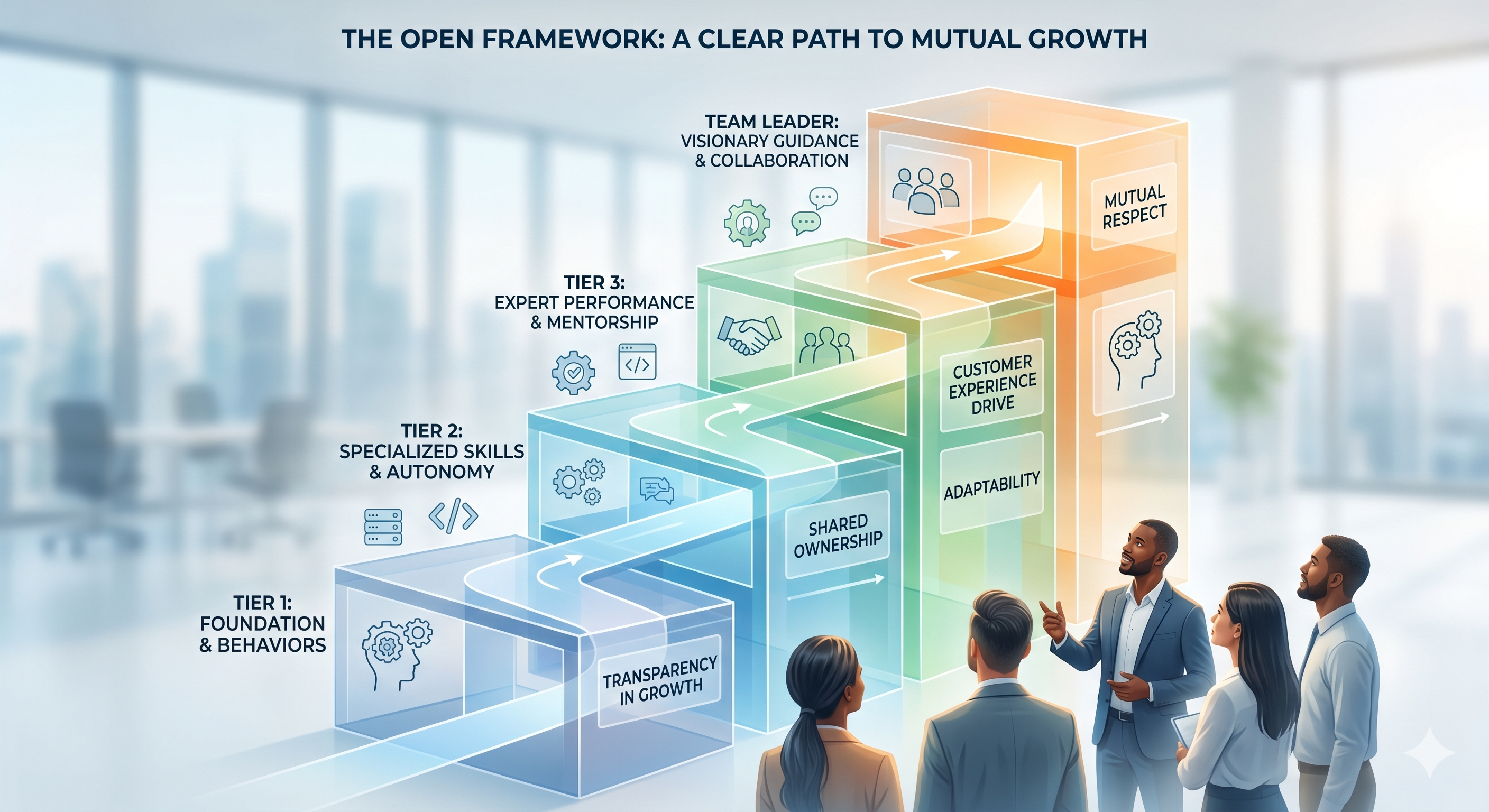
Imagine an open framework where an engineer doesn't have to guess what it takes to reach the next level or step into leadership. Instead, they have total transparency over:
The Complete Picture: A clear understanding of the technical and behavioral traits required at every tier.
Their Current Position: Honest, consistent dialogue about where they stand right now, without the anxiety of an annual review surprise.
The Path Forward: A shared vision of how to close the gap between today and tomorrow.
Clarity removes the friction from career progression. When you replace ambiguity with transparency, you replace frustration with motivation.
Mutual Growth: The Ultimate ROI
When we are completely transparent about what the business needs and how success is measured, a powerful shift happens.
Engineers can stop guessing what their manager wants and start actively planning their lives and career trajectories. In return, the business gains the ability to confidently plan its growth. You can look at your team and clearly see the pipeline of future Tier 3 specialists and tomorrow’s Team Leaders taking shape.
Transformative leadership isn't about dictating a path; it is about illuminating the terrain. Are you giving your team the clarity they need to navigate their own growth, or are you just handing them a checklist?

Chris Malyon
Chris writes about engineering capacity, leadership, and what it actually takes to build high-trust IT teams. He's the author of Changing the Game and speaks regularly on enterprise IT transformation.
Connect on LinkedIn →